
Since 10 October 2025, EU Regulation 2024/900 on the transparency of political advertising — commonly known as the TTPA — has been in effect. What was designed as a regulation for greater transparency has triggered a chain reaction that fundamentally alters the European advertising market for political communication. Meta, Google, TikTok, and Snap have completely banned political advertising in the EU in response.

What the TTPA Regulates — and Where the Problems Lie
The TTPA requires advertisers and platforms to ensure comprehensive transparency for political advertising. Every ad with a political dimension must be clearly labelled, including information about the commissioning party, costs, and targeting criteria used. The use of sensitive personal data for targeting political advertising is also heavily restricted.
The problem lies in Article 8 of the regulation. The definition of what qualifies as "political advertising" is deliberately broad — and therefore vague. According to the TTPA, political advertising encompasses not just election advertising in the narrow sense, but potentially any paid communication that is capable of influencing political discourse or the outcome of an election. For the major platforms, this ambiguity represents a significant compliance risk. Their solution: a total ban.
The Platform Response: Blanket Ban Instead of Differentiated Compliance
Meta announced in September 2025 that it would block all political advertising in the EU. Google, TikTok, and Snap followed suit. For platforms whose business model is built on maximum scalability, a complete ban is operationally simpler than individually reviewing every ad for political relevance.
What constitutes a calculated business risk for Meta and Google, however, hits the affected organisations with full force. And the list of those affected extends far beyond political parties.
Who Is Actually Affected: NGOs, Foundations, Associations
The TTPA affects every organisation whose paid communication could be classified as politically relevant. In practice, this means: Doctors Without Borders can no longer run campaigns about the root causes of displacement via Meta. Bread for the World can no longer reach target audiences for campaigns on development policy. Deutsche Umwelthilfe cannot place sponsored posts about climate protection on Instagram.
For these organisations, social media platforms were often the most efficient channel for generating attention around socially relevant issues. That channel is now closed — not because the organisations violated any rules, but because the platforms refuse to bear the compliance risk.
The Disinformation Paradox
The particular irony: while legitimate organisations have lost access to paid reach on major platforms, organic disinformation remains largely untouched. Algorithmically prioritised content that maximises outrage and polarisation is not captured by the TTPA — it applies exclusively to paid advertising.
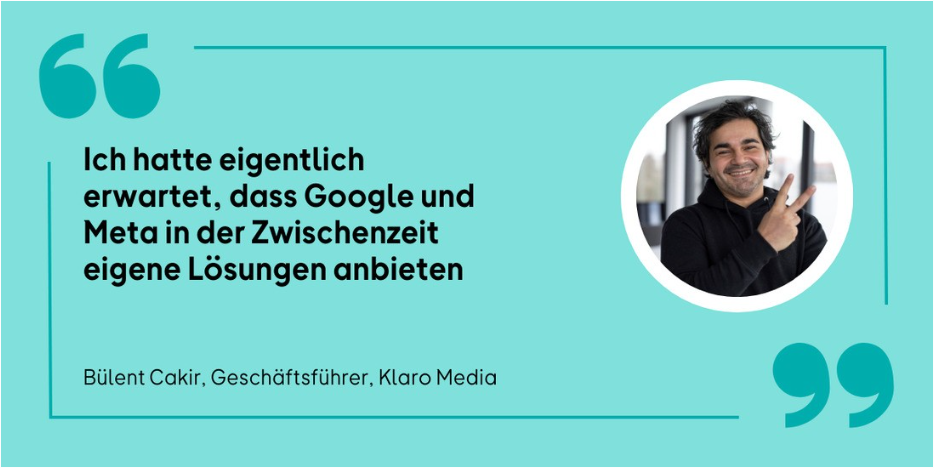
"What the AfD fabricates, and how it is partly prioritised by platform algorithms, is unfortunately next level. That is precisely why democratic organisations need paid alternatives to remain visible in public discourse."
The current situation creates an asymmetric information environment: actors who deliberately polarise benefit from algorithmic amplification. Organisations that provide fact-based education lose their most important paid distribution channel. Correcting this imbalance is not merely a media strategy challenge — it is a democratic necessity.
The Solution: TTPA-Compliant Advertising on European Infrastructure
At Sovereign Media, we responded to this development before the TTPA came into force. Our solution is built on a fully European tech stack that enables TTPA-compliant political advertising — outside the major platforms, but with comparable reach.
In concrete terms: Display, Video, and Mobile advertising on high-quality European media websites. All data processing within EU jurisdiction. All TTPA transparency requirements — labelling, commissioning party transparency, targeting disclosure — are natively integrated. There is no compliance risk because compliance is implemented by design.
Programmatic delivery is handled through European ad-tech providers explicitly committed to TTPA compliance. The inventory comprises news portals, specialist media, and editorial environments — contexts in which political communication is not only permitted but contextually appropriate.
Why This Matters Now: 2026 State Elections
Germany faces a series of state elections in 2026. For political parties, party-affiliated foundations, public affairs agencies, and civil society organisations, the planning horizon for campaigns begins now. The realisation that Meta and Google are no longer available as channels must be factored into media planning.
Organisations that engage with TTPA-compliant alternatives early will have a considerable advantage. They can scale campaigns while competitors are still searching for solutions. They can test and optimise targeting strategies instead of pivoting to untested channels at short notice.
The New Programmatic Landscape Beyond the Platforms
The withdrawal of major platforms from political advertising creates a vacuum — and with it, an opportunity. European programmatic networks that treat TTPA compliance as a feature rather than a constraint can position themselves as the primary infrastructure for political communication in the EU.
Premium publishers are deliberately opening their inventory for TTPA-compliant political advertising because they understand the editorial proximity to political topics as a quality indicator. At the same time, specialised verification services are emerging that verify campaign TTPA compliance in real time. The market is reorganising itself — along European lines.
Conclusion: Regulation as an Infrastructure Question
The TTPA is not a restriction that can be waited out. It is the regulatory framework within which political communication in the EU will take place — permanently. The question is not whether, but how quickly organisations adapt their media strategies.
Dependence on US platforms for political communication was always a strategic risk. The TTPA has materialised that risk. Those who invest in EU-sovereign infrastructure now are not just investing in compliance — they are investing in their organisation's long-term capacity to participate in democratic discourse.
This article is based on reporting by OMR (Online Marketing Rockstars) from 4 December 2025, supplemented with the perspective and solutions of Sovereign Media.